Take the Sats Now. Pour the Coffee Later.
Your customers buy store credit over Lightning. The bitcoin lands in your own wallet today. What you owe them is a coffee — and a coffee is priced in coffee, not in exchange rates.
The Best Trade in Retail
Get paid in the hardest money there is. Deliver goods later, at your own prices.
Paid Up Front, in Sats
The card sells for its full face value over Lightning. The sats settle into your own wallet the second the invoice clears. SatsRail never holds them, never routes them, never sees a balance it could freeze.
You Owe Goods, Not Money
The liability on your books is a coffee, a haircut, a class. It is priced in your own currency and delivered from your own inventory. You absorbed the exchange rate at the moment of sale — deliberately. That is the whole trade.
The Float Is Yours
Every outstanding card is working capital you already collected. Balances that never get spent stay on your side of the ledger — and because they never expire, the customer keeps the right to spend theirs whenever they walk back in.
Say the risk out loud: when you sell a card you take the bitcoin and take the price exposure with it. If bitcoin falls, the coffee still gets poured at the price you promised. Merchants who want the sats want exactly that trade. Merchants who don't should keep selling coffee one invoice at a time — the POS does that for free.
Two Kinds of Card
One holds value. One holds a promise. Both live on the same rail.
Prepaid Cards
Store credit, paid in bitcoinA fixed denomination your customer buys once. $25, $50, $100 — each one is its own program, and each one shows up in your catalog as an ordinary product you can sell anywhere you already sell.
- Sold through the POS, a payment link, an embed button, or the API
- Code and QR issued the instant the payment lands
- Balance denominated in your currency, not in sats
- No expiry date, no dormancy fee, no maintenance fee — ever
- Every card traces back to a paid order. An audit trail by construction
- Face value capped at $1,000 per card for US merchants
Loyalty Punch Cards
Free — no money in it, everBuy ten, get one free. Anywhere from 1 to 30 spaces, your reward text, your accent color. Nothing is sold, nothing is stored, nothing is owed but the promise you printed on the card.
- Customers join by scanning the poster you print from the dashboard
- One card per customer, forever — it resets after each reward instead of dying
- The stamp lands live on their phone while they stand at your counter
- A full card locks until staff hands the reward over — no accidental over-punching
- Holds no balance, so it can never be spent, drained, or lost as money
From Program to Pour
Four steps. No hardware, no card printer, no processor.
Design the Program
Name it, price it, pick an accent color and an icon. You see the customer's card render as you type. The program becomes a product in your catalog automatically.
Sell It Like Anything Else
At the counter, over a payment link, from your website, or through the API. The buyer pays a Lightning invoice on your own wallet. Ordinary order, ordinary sats.
The Card Mints Itself
The moment the payment lands, the code exists. It prints on the terminal, emails to the buyer if they left an address, and fires a card.issued webhook to your systems.
Redeem in One Scan
Point the terminal camera at their QR. The balance appears before you charge anything. Confirm, and the debit is a ledger entry — no invoice, no wallet, no exchange rate at the till.
One Invoice.
Then Never Again.
Lightning at a counter is a round trip: generate, display, scan, open wallet, confirm, wait. Twelve seconds when the room has signal. Longer when it doesn't.
A regular who buys coffee twenty times a month does that round trip once, in January. Every visit after is a scan and a debit. That is the difference between bitcoin being possible at your counter and bitcoin being the fast lane.
- Terminal generates an invoice
- Customer digs out their phone
- Unlocks, finds the wallet, opens the scanner
- Scans, confirms, waits for the route
- Terminal waits for settlement
- Staff scans the customer's code
- Balance shows on screen
- Confirm. Done.
No invoice. No preimage. No sats in motion. The money moved back in January.
The Rules We Don't Break
A card is redeemable at the merchant that sold it. Nowhere else, in any form. That is not a feature we forgot to build — it is a wall, enforced in five separate places in the code.
Closed-loop store credit — redeemable solely at the issuing merchant, with no cash-out and no transfer — is a category regulators already understand. Opening any of those doors would change what the product is. See Regulatory Compliance.
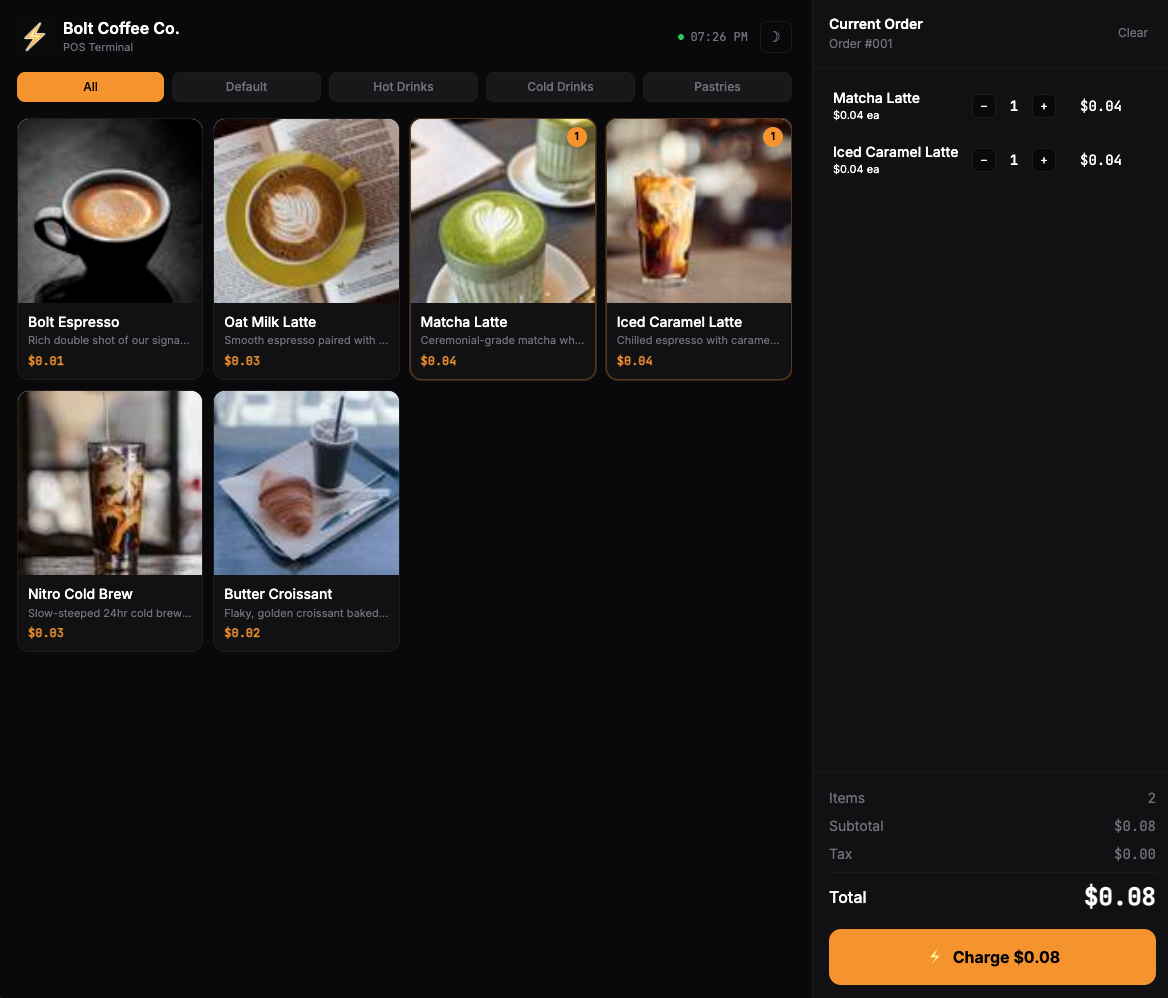
Your POS Already Speaks Card
Cards are a tender in the SatsRail POS, sitting next to Lightning and cash. Nothing to install, nothing to buy.
A Wallet for the Cards, Not the Coins
Customers can keep their cards in a thin account — email and password, nothing else. No KYC, no phone number, no bitcoin knowledge required.
Cards Are Just API Objects
Programs, cards, and the ledger are first-class resources. Build your own terminal, your own kiosk, your own vending machine — the same endpoints the SatsRail POS uses are the ones you get.
- Codes are looked up by POST, never in a URL — a bearer credential does not belong in access logs
- Every debit takes an idempotency key, so a double-tapped button or a retried request charges once
- Row-locked balances — concurrent redemptions on the same card cannot overdraw it
- Webhooks for
card.issued,card.debited,card.punched,card.reward_redeemed
# Check a balance before charging
POST /api/v1/m/cards/lookup
Authorization: Bearer sk_live_...

{ "code": "card_7b3f9c21d8e64a05b1cf2739ae604f7a" }

# →
{
  "object":            "card",
  "masked_code":       "card_••••4f7a",
  "program_name":      "Ridgeline $50",
  "tracking_mode":     "balance",
  "balance_cents":     3250,
  "formatted_balance": "$32.50",
  "currency":          "usd",
  "status":            "active",
  "redeemable":        true
}
Who Sells Cards
Anywhere the same customer comes back more than once
Coffee Shops
The canonical case. Sell a $50 card in January, pour coffee all quarter, skip the invoice every single morning.
Barbers & Salons
Prepaid cuts and a punch card on the same rail. The tenth trim free, tracked without a paper card that lives in a wallet and dies in a washing machine.
Gyms & Studios
Class packs, paid up front in sats. Ten sessions bought once, drawn down one scan at a time at the front desk.
Restaurants & Bars
Gift cards are the highest-margin thing on the menu. Sell them in sats and the float lands in your wallet before the kitchen fires a single order.
Meetups & Conferences
The best orange pill is a gift. Hand someone a card bought with sats and their first bitcoin transaction is one they enjoyed instead of one they studied.
Retail & Circular Economies
Bitcoin towns, beach circuits, festival strips. Locals load a card once and spend it all season without a single wallet round trip.
Common Questions
The ones merchants actually ask
Cards are rolling out in early access
Sell the Card Today. Pour It All Year.
No card printer. No processor. No hardware. Your wallet, your customers, your ledger — and the sats arrive before the coffee does.